






THE GRAND NATIONAL
In 1837 Mr William Lynn, proprietor of the Waterloo Hotel in Liverpool's Ranelagh Street organised the first running of The Grand Liverpool Steeplechase. This became known as the Grand National in 1839. He had been encouraged by the extra trade generated by the Waterloo Cup Hare Coursing event, which the Liverpool entrepreneur had inaugurated in 1836.
So Mr William Lynn was responsible for two events that involved cruelty to animals.
FAACE held annual demonstrations against the Waterloo Cup Hare Coursing until it was banned in 2005.
Every year FAACE holds a demonstration against The Grand National race meeting at Aintree, Liverpool.
The Hidden Truth
If you watch the 'National' on television the cameras quickly turn away when a horse falls, in case our sensibilities are offended. You don't usually get to see the screen that is erected to hide the bitter truth of the death of a horse.
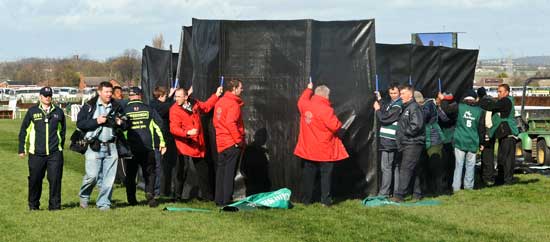 |
| Screens are erected around a dead horse during The Grand National |
2011 was an exception to the rule when the bodies of two horses covered in green canvas sheets were shown.
There was also the spectacle of the winner Bellabriggs in such a state of exhaustion that he nearly collapsed and needed to have water thrown over him and to be given oxygen. Jason Maguire, his jockey, received a five-day ban for excessive use of the whip.
All of this resulted in 'Changes to The Grand National to Enhance Safety' being declared by Aintree on 15th August 2011.
Cynical Changes
Bechers Brook: the drop in height of the ground from take off to landing will be reduced by 4 inches, but still leaving a drop of 11 inches.
Fence 17: The drop will be reduced by a small amount.
Fence 4: The height will be reduced by 2 inches - which still leaves it at 4 foot 10 inches.
The height of toe boards on all National fences will be increased to 14 inches. These boards are to assist horses in determining the base of the fence.
|
The changes are a cynical move, to address the bad publicity and shock of the general public that resulted. As was stated on BBC TV’s North West Tonight “Aintree says”…. “ the changes will not sanitise the race”. What do the organisers mean by this? This is said to have been done in consultation with the RSPCA and the World Horse Welfare. Can you believe this? The changes are all to do with money, to make it seem that all is well for the horses now. They are frightened that attendance could fall, and with this a loss in revenue, if the mood of shock persists. |
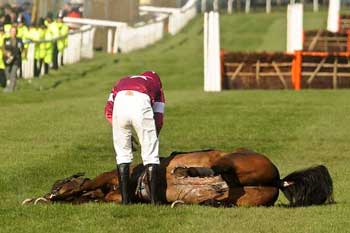
In 1989 the fences were “tweaked” with RSPCA approval. At the time it was argued that the small changes that were made would make the race safer. In fact, it made it faster and just as dangerous and the horses have continued to die. Will it be any different this time?
Facts
In the 10 years prior to the 1989 changes to the fences, there was a total of five deaths. However, in the 10 years after the changes there were 10 deaths. From 2002 until 2011 there have been a total of nine deaths.
If only people would think about the consequences for the horses and the cruelty involved, perhaps they would think twice before having their annual "flutter" on the National. We should think very seriously before we help to pass a death sentence on these horses for our gain.
Click button
to listen to
Tony Moore of FAACE talking about these changes to BBC TV’s North West Tonight.
Recorded the day before the 3rd December 2011 race meeting at the Grand National course, during which three horses fell at the adjusted fences - including two at Bechers Brook.
... more Cynical Changes
On the 27th September 2011 the British Horse Racing Authority (BHA) made another attempt to make horse racing more acceptable.
After the debacle of The Grand National this year, with the death of two horses and the racing ban of the winning jockey of five days racing for over-whipping Bellabriggs, the BHA have decided to do something about the whipping of horses.
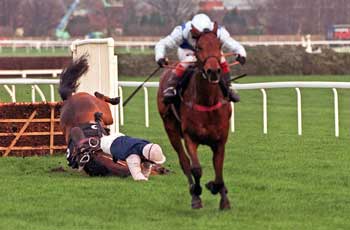 |
The offending jockeys will banned for whipping a horse more than 6 or 7 times, according to the race, and will have their winning money stopped. If they offend more than 3 times they risk a revue of their licence. Professor Tim Morris of the BHA said that to ban whipping outright would be to give in to the animal rights groups. He said that the whipping doesn't hurt. Why then is the BHA bringing in the new rules on whipping? Perhaps if it doesn’t hurt, an extra penalty could be applied to a guilty jockey that they receive as many whip strokes as they have dealt to the horse. |
What a Surprise
In November 2011, because of complaints by penalised jockeys, the BHA started backtracking on the rules and penalties for excessive whipping. We await furthering watering down of this farcical situation with bated breath!
In February 2012 the expected changes to the whipping rules took place. The race stewards now have to use their “discretion” in judging if jockeys have whipped excessively and the jockeys will have their suspensions diluted.
August 2013
Crabbies is now the main sponsor of this cruel event
After the withdrawal of John Smith’s as main sponsor in November,
Crabbies have announced that they are the new main sponsor of the Grand National.
Following in the footsteps of Martell (Brandy/Cognac) John Smiths (Beer) we now have Crabbies (Alcoholic Ginger beer). It seems to continue the theme of the Grand Nationalrace meeting,animal cruelty and excess drinking.
The Grand National is one of the show cases of the horse racing industry. It is also one of the deadliest for the horses in the UK. Crabbies is endorsing this cruel and deadly race.
To contact Crabbies and let them know how you feel, GIVE THEM A WARM WELCOME!
www.crabbiesgingerbeer.co.uk/contact/
Twitter: @CrabbiesUK
Facebook: www.facebook.com/crabbiesgingeralcoholicbeer
Press: www.crabbiesgingerbeer.co.uk/2013/08/28/the-crabbies-grand-national/
Parent Company: www.halewood-int.com/contact/
The UK clothing retailer Matalan supports the Grand National
Three horses died in this year's Grand National race meeting and four died in last year's race meeting. There is no way to make the Grand National horse-friendly and safe.
The reason the Grand National can continue is because of the money generated and Matalan helps in this regard with its sponsorship.
- Matalan runs a number of pre-race events, giving tickets as prizes.
- Matalan advertising posters adorn the Aintree racetrack.
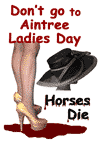
- Matalan have a style contest at the racecourse on the Friday - 'Ladies Day '- when women dress up in their finery.
Whilst the fashionistas are flaunting themselves, horses are dying.
A Facebook page has been created to raise Matalan's awareness that this kind of sponsoring is a bad idea:
http://www.facebook.com/StopMatalanSupportingHorseCruelty
September 2012
More attempts to allay the public’s growing fears for the horses
It was announced that the 2013 Grand National would start 90 yards nearer the first fence. The no-go’ zone for runners and riders would also be increased to 30 yards from the starting tape.
This is to make the 40 horses arrive at the first fence at a slower pace, but it also means that they all arrive at the same time. Another danger point.
November 2012
Sponsor withdraws
It was stated that 2013 would be the last year that John Smith’s would sponsor the Aintree Grand National race meeting. The decision to end the sponsorship after nine years was a commercial one although the safety record had been a consideration, said David Jones, a spokesman for Heineken UK. John Smith's is one of the Dutch brewer's brands
December 2012
More fence changes
Announcements were made about the makeup of the fences. Additional levelling to the landing side of four fences, including Becher’s Brook, will be implemented, but the BHA resisted calls for further reductions to the size of some obstacles – and the 40-strong field.
2013 Grand National Sponsor Matalan
This year Matalan is not only sponsoring the Grand National Ladies Day, but has two races bearing its name.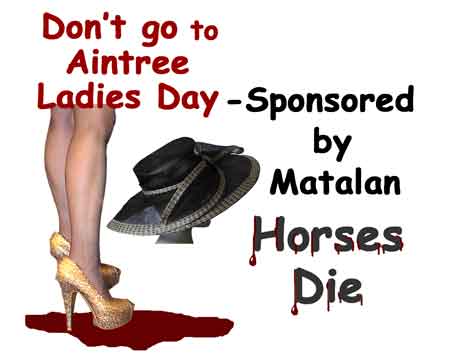
Demo against the Grand National - April 2014
A demonstration will take place on the day of the Grand National, Saturday 5th April from 11am to 2pm, opposite the main entrance to the Aintree Racecourse on the A59. This is in front of the Aintree railway station entrance.
Please join us and swell our numbers if you can. It will make a difference.
Please spread the word as much as you can.